
EN

{fastsocialshare}

I, as many of my peers in the medical device industry, am still, after 20 years in the business, amazed at the amount of time and effort spent on technical documentation.

The innovation and progress in the field of technical documentation don't, in any way, reflect the progress that has been made in the medical device innovations themselves.

Up to 50% of the total development effort of medical devices is spent on documentation activities. 

Furthermore, it is apparent that very few people prefer spending time with documentation activities compared to innovation activities.

This is obviously a competitive dimension in our industry with massive efficiency gains to be made.

The one who masters technical documentation better than his competitor will 

  • shift resources to innovation and build better products
  • faster market access 
  • hit the revenue stream earlier

There is simply gold to be picked up from the floor here.

So why are we not talking more about this? Does it have to be this way?

In the video below, presented at MedConf 2020, we elaborate on how medical device manufacturers can trim their documentation efforts while still remaining compliant.


If you want to assess your own documentation process, reach out to us on This email address is being protected from spambots. You need JavaScript enabled to view it.
{fastsocialshare}

So you have realized that an Application Lifecycle Management software probably would make your medical device development more efficient?

Maybe you have experienced that your team:

  • spends a lot of time documenting Design Controls?
  • has difficulty maintaining the traceability for your product?
  • lacks confidence in your current technical file?

There are many good ALM tools out there so it should not be too hard to pick one, right?

However, acquiring an ALM tool is a significant investment and you want to make sure that you pick one that addresses the particular challenges facing your team.

So where do you start?

Writing a Request for Proposal

A common starting point is to establish your organization's needs in a “Request for Proposal” document a.k.a. RFP. The RFP will be sent to a number of vendors and will help you 

This approach has several benefits. First of all, to explicitly spell out what the tool shall do for you will force you to concretize your needs. You shall also include other stakeholders to make sure you are informed about and address their concerns as well. This exercise will also reveal conflicting and ambiguous requirements which are always better to address sooner rather than later.

We recommend this RFP practice since it provides structure to the evaluation process. However, the RFP phase can sometimes lead to an “Analysis Paralysis” situation where an unproportionate effort is spent on establishing the “complete” RFP. Sometimes this is caused by incorporating too many stakeholders in the process, conflicting visions or needs or simply as a fear of failure when making a significant investment. Worst case, the RFP process can drag on for months, swell uncontrollably in size and, in the end, cost much more than the tool itself.     

We recommend you prioritizing the core needs that initially triggered the evaluation. Keep the RPF short and concise!

For a medical device ALM, this RFP should at least include requirements for:

  • Requirement Management
  • Establishing Traceability
  • Risk Analysis capabilities
  • Management of Verification & Validation activities
  • Proper versioning of Documentation and Artifacts
  • Establish reports that satisfies standards like ISO 13485 and ISO 14971
  • An automatic Audit Trail of all changes
  • Enable you to fulfill your Quality Management System

(We consider these the minimum features required for compliant medical device development).

Since we operate within the medical device scope, 21 CFR Part 11 Electronic Records (most of the artifacts in an ALM!) and Electronic Signatures (depending on how you implement the sign-off in your organisation) shall be addressed by the ALM. This will generate a number of requirements here summarized as:

  • 21 CFR Part 11 Ready (note that a tool in itself can never be 21 CFR Part 11 compliant. Final compliance always depends on processes within the organization)

As always, remember to make sure the requirements are testable.

Testability equals CSV

In our line of business, a Computer Software Validation, CSV, (more on that here) will eventually be used to validate the ALM. The RFP can provide valuable input to this activity and you should be able to derive your CSV User Requirements from your RFP.

Even though low CSV efforts may not be a formal requirement in itself, the CSV activity will definitely be a cost driver that should have an impact on your purchasing decision. In some cases, the CSV cost can surpass the cost of the tool itself.

The CSV effort is typically driven by:

  • The complexity of your QMS (e.g., number of Design Item types, number of different relationships between design items as well as number of SOPs to test in the validation).
  • The complexity of your CSV process (the rigorousness and granularity required)
  • Approach to tailor the tool itself a.k.a. customizable or configurable.

Finding out the vendors tailoring approach must definitely be part of the RFP. Do not forget to consider required integrations between the ALM and external tools. Integrations are notorious for requiring additional programming efforts.

If the tool has to be scripted/programmed to tailor it to your organization, the system falls into the CSV category “customizable“ for which the validation efforts for a system is expected to be higher (including deeper testing, managing risks, code reviews, etc).   

A configurable ALM is therefore preferable since:

  • The initial tailoring costs are lower
  • The initial and subsequent CSV costs are lower
  • Customization may impact the compatibility with future ALM releases and forward compatibility
  • Administrating the tailoring over time will require specialized personnel

Require the ALM to fit with your Quality Management System

Your QMS, development processes, and templates have been carefully developed to specifically address your company’s unique situation. Compromising your QMS may have significant effects on compliance and efficiency.

Some ALM  tools are pre-configured and you are required to make substantial changes to your QMS in order to fully utilize its potential. Unless you are considering rewriting your QMS for other reasons, we would discourage you from doing too big changes to an existing QMS since it may affect existing certifications and jeopardize compliance.

Another option to bridge the difference between the QMS and the ALM to set up processes and documentation that translates/maps between the tool and your QMS. However, operations that require manual mapping as described are notoriously error-prone and subjects your technical files to an increased risk of errors and inconsistencies.

Instead, the ALM should ideally adapt to your QMS, reflect your processes, use your templates and present your terms and notions in the GUI. This will lead to a higher level of acceptance, lower the learning curve, speed up the tool adoption process and reduce the risk of errors. For these reasons, we at Aligned always strive to make the tool follow the QMS.

The impact on your QMS should ideally not be more than an additional work instruction/SOP, stating that an ALM is used to fulfill certain activities defined by QMS. This work instruction/SOP will be a valuable input to your CSV activities.

To get you started, we have put together an example RFP spreadsheet. Download it here: Medical Device ALM Request for Proposal Template.xls

One Tool to Rule Them All or a Landscape of Tools?

What is the required scope of your ALM? This is a very common question often discussed in terms of cost. Intuitively, one IT tool must be cheaper to maintain than multiple tools, right?

A large tool spanning many areas of activity may have the benefit of providing integration, but from experience, dedicated tools usually are really good at what they do and definitely have their eligibility as well. Within a large organisation there will be tool boundaries. This fact may even simplify the introduction of an ALM tool and lower any business risk if you aim at building a working tool landscape rather than replacing it all at once.

The consideration of integrating with other tools can also be part of the RFP. We recommend however to keep the priorities right between core functionality and ‘nice to have’s’. The need to integrate different tools may be fulfilled over time.

Go through your RFP again and check if tools already existing in your organisation may already fulfill your requirements and adjust any priorities accordingly.

Next Step, gather Hands-on Experience!

Your RFP is not going to get you answers to all of your questions. Now it is time to experience the tool first hand. This is a crucial step in your evaluation. Most vendors will affirm every one of your requirements but you will quickly realize that the “how” is more important than the “what”.

Ask if you can access and evaluate the tool yourself. The vendor’s response will give you some important indications. Do they trust the ALM to be self-explanatory or will they require you to take training?

At this point, there are a few points on what to expect from the vendor:

  • You shouldn’t need to buy any infrastructure to install and run the evaluation version.
  • The evaluation should not require a significant time investment on your part
  • Any training and/or customization cost for the evaluation shall be minimal

Try to account for the subjective impression from the hands-on experience in your evaluation. They will be an important factor in embracing the tool within your organisation.   

Estimating the total cost

To prepare for the last step, it is time to request quotes from your vendors. Make sure these quotes include all cost-driving factors through-out the ALM’s lifecycle to accurately facilitate comparison between vendors.

An accurate lifetime cost estimation shall include:

  • Cost of Licenses
  • Cost of Service and Support (find out what is included)
  • Cost of configuration/customizing (how long until the system can be used?)
  • Cost of training
  • Cost of CSV activities
  • Cost of import/transfer of legacy data into the ALM
  • Cost of IT Infrastructure (include cloud costs, software licenses for OS, databases etc.)

Lifetime costs will inevitably arise from maintaining the tool:

  • Is the tool so complex to administrate that we need to build an internal team (or optionally buy this service from the vendor or 3rd party service provider) covering this new expertise?
  • Or you can rely on the vendor (ideally this is already part of the support agreement) for maintenance

Wrapping up the evaluation

Having the input from the RFP and the hands-on experience, you can now hopefully make a well-informed decision based on the capabilities of the ALM. You have gathered knowledge about how to make the tool will fit in your organisation and IT landscape.

At this stage, as a note of caution: a given tool will not solve all your problems. Tools do speeds up processes, provide structure and checks but in essence, they rely on improving something that already works.

To summarize the points:

  1. Formulate an RFP, focused on medical device development
  2. Plan ahead for CSV
  3. Check for fit with your QMS
  4. Gain hands-on experience
  5. Establish total lifetime cost

Best of luck with your evaluation!


{fastsocialshare}

Since Covid-19 delayed the introduction of EU-MDR and EU-IVDR until 2021, many companies have been granted an unexpected reprieve from adhering to the changes to the Medical Device Directive (MDD). This extra time should enable many firms to more adequately prepare and roll out these changes in a more orderly fashion.

MDR may also finally compel device manufacturers to eschew their paper or MS Office based processes due to the necessary documentation needed to adhere.

The actual changes in regulations are not as drastic as first appearances may lead one to think, but they are more encompassing. At 174 pages for MDR and 157 for IVDR, the new regulatory documents are physically 3 times longer than the 60-page predecessor, MDD, or the very thin 37 pages for IVDD, and have many more annexes than the former regulations.

That said, is it really such a huge difference for many companies?

Yes, yes, a thousand times yes!

For many companies, the answer is simply “yes”. Many more medical devices will fall under the new regulations and necessary documentation required by MDR. For many midsized and smaller companies, this can be problematic. Larger device manufacturers have the infrastructure already in place to handle the additional QA/RA efforts needed. For those who were able to avoid regulatory control, MDR/IVDR will be a huge change and challenge.

Bigger and broader

The definition of “medical device” will now include many previously non-medical and cosmetic devices. Devices used for sterilizing, disinfecting, and cleaning of devices – including epilation lasers and contact lenses, for example – will now be labeled as medical devices.

If that isn’t enough, many medical devices will move to a higher risk class and there will be a new classification for reusable surgical devices. IVD’s in particular will have a large increase in oversight and there will now be 4 risk classes and those will cover around 90% of those devices.

Previously only 10% were covered by risk classifications whereas, with IVDR, the definition of an IVD has been expanded to include software and companion diagnostics.

Going forward, even laboratory devices, cleaning & sterilizing devices, and instruments are covered by Class A, with Classes C &D handling life-threatening devices, with D being the highest risk classification. Class B will now be the “default group” covering lower-risk devices such as cholesterol, pregnancy, fertility, and other urine-based testing.

Safety, safety, and more safety

There is also a much larger focus on “safety” – the word appears 290 times in MDR while it was only mentioned 40 times in the former MDD. To prove safety and performance claims, device manufacturers will have to create and maintain more in-depth clinical data than previously expected.

There will be a centralized EU portal that device manufacturers will be required to use when reporting their incidents, injuries, and deaths. This will provide a bit more transparency in regards to safety-related information for patients as they will now have access to this data for a longer time frame.

Not only initial risk is covered but also the continuous, lifespan of the device risk has to be measured. In addition to an increased focus on risk, the clinical effectiveness of the device must be documented.

Wider QMS coverage

What all of this means is that almost every medical device company will require a quality management system (QMS). And not just a QMS that complies with ISO 13485:2016, but one that includes post-market surveillance for each device. The goal of this is to assist manufacturers in better understanding their device throughout its entire life cycle. What is also very important is that no products will be “grandfathered” which means you cannot simply reuse your CE info to get this done.

All devices – even those currently on the market – must conform to the new IDVR standards. As a result, most companies’ Technical File (now called your Technical Documentation) will increase in size. As per EU regulators, your clinical evaluation (CE) Technical Documentation will include all technical information demonstrating how performance and safety are verified and validated by your risk assessment, manufacturing, PMS, design controls, etc.

Device manufacturers must also describe how to handle and document changes to the Technical Documentation in a formal procedure. There is no longer a distinction between a Technical File and a Design Dossier.

In the EU MDR Annex 1 replaces “Essential Requirements” with the now named “General Safety and Performance Requirements.” On the surface, the requirements are quite similar, but they now also include requirements for active implantable devices and bring forth the use of a benefit-risk-ratio.

Bigger documentation demands better tools

All of this additional information and documentation will create an all-encompassing technical library of your device. This means many companies should strongly consider abandoning the “paper / MS Office” and e-mail based processes in favor of software tools “built for purpose”.

Such artifact-based systems are better able to support the transparency, traceability, and control needed to meet the new requirements of MDR/IVDR. Having the ability to link the additional safety analysis that is required to requirements, specifications, mitigations, verifications, and validations in a very transparent and efficient manner will benefit both the device manufacturer and auditors.

Being able to find inconsistencies prior to an audit should always be your goal as this will save you time and money. If the change to the regulations due to MDR/IVDR is going to be smooth sailing for your company, you will need to be as confident as possible in your Technical Documentation.

By adopting an artifact-based system that adheres to your process, the learning curve and other barriers to entry are lowered or completely eliminated. With software tools, you can decrease costs, speed up development, lower testing time, decrease risks and have complete faith in the Technical Documentation you are producing.

Utilize the need to adopt MDR/IVDR as an opportunity to effect changes that modernize your processes.

This will enable you to start to work smarter instead of harder.


{fastsocialshare}

Traditionally, many medical device manufacturers have chosen the Waterfall process as the best way of managing their development with the assumption that regulatory bodies preferred this method.

While the regulations do not prescribe a method for designing and developing a product, some FDA QSR related guidance, such as the FDA’s “Design Control Guidance for Medical Device Manufacturers”, use a language that points in this particular direction.


FDAProcess


The medical device manufacturers’ focus, due to the uncompromising effects of not being compliant, has always been on creating documents and reviewing those documents - with organization, compliance, and quality being more important than end-user-focused and efficient development. Testing processes have also stayed true to this path. As most of the development in the medical device industry is subjected to these forces, we often see the following “testing truths”

  • Testing starts on completion of components at the end of the development cycle
  • Since formal testing is documentation heavy, most testing is one-off.
  • Involving the end-user tends to begin at design validation after the product is either completed or nearly completed
  • The rush to decrease the time-to-market causes hasty testing without nearly enough meaningful test coverage
  • Manual testing is done really manually – meaning printed tests, checkoff sheets, and then feedback and results are input manually back into the Word test plan.
  • Regression testing is also done manually which causes burned-out testers who are more prone to make errors over time.

With time, these drawbacks have become more and more obvious to the industry as they result in increased cost, lower quality, and lower end-user acceptance.

Although Agile development appears to be a promising alternative, its (unwarranted) reputation of being unstructured and informal, focusing on speed rather than quality, has made the traditional medical device manufacturer shun it.

After all, does it not seem wiser to use a tried and tested, compliant development process, known and accepted by notified bodies, than to gamble with an unknown alternative, even though the cost might be a bit higher?

On the contrary. The truth is that many of the industry’s major players, including GE Healthcare, Medtronic, Roche, St. Jude Medical, Cochlear, Boston Scientific and Toshiba have adopted the agile, iterative development approach. However, going agile is not always an all-or-nothing proposition.

It is up to the manufacturer to pick and choose the parts from the agile methodology that makes the most sense for their business.

agile4

Using an iterative approach will allow you to enjoy earlier and more frequent testing. One of the clear benefits of the Agile process is that testing is introduced earlier in the development process. With shorter development cycles, testers have the advantage of finding issues earlier, which should provide an improved overall quality further down-stream. This is also the case for formative usability testing, in line with IEC 62366-1:2015. The earlier we receive feedback from our target customer, the better we can steer development towards producing a viable and accepted product upon release.

Test early, fix early

Introducing test activities early in the development process allows early fixing of detected quality issues. It is a long proven fact that it is much easier and less expensive to fix issues and solve problems earlier in the development cycle when there are fewer dependencies and design is fresh in the mind.

Once your development has progressed, it is natural to forget why something was done and the difficulty to avoid serious impact when introducing a change increases dramatically.

By having frequent release cycles, you have an opportunity to adjust as you go so that your path fits your testing – both for errors as well as for acceptance. Requirements never stop changing and evolving - your testing should mirror this and your development should be in line with the results.

Involve the end-user on a regular basis

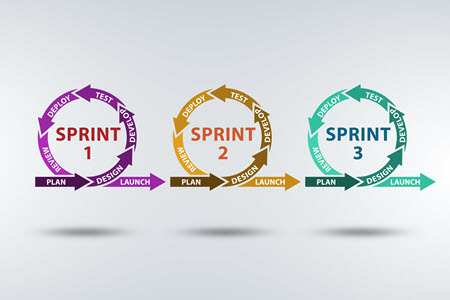
The idea of Agile, or the iterative development approach, is to release working prototypes often, review the work done, improve on that work in the next iteration or sprint.

While prototypes may not always fit the development needs of medical devices, the iterative approach focuses on feature-driven iterations which can be tested. Either way, the focus is customer-based – accepting and implementing requirement changes as they come in to better fit the customers’ expectations.

Shorter release schedules allow for more frequent reviews, which helps the development team stay on track while improving both quality and compliance adherence over time.

Testing – especially usability testing, a prescribed activity by MDR and FDA QSR 820 – will be frequent and timely, enabling teams to build quality into the iterations at a much faster speed. This will in turn shorten time-to-market and deliver a higher quality product as you will see an increase in the test coverage capabilities with a more frequent and early testing process.

Working features will be produced in every iteration and verification will be achieved on these frequent builds through unit tests, manual verification & regression testing. By finding the issues early, there is a significant lowering of development risks for the project and ultimately the product.

Addressing high risks with early testing

Using a risk-based approach, an established best practice in medical device development and prescribed by standards like ISO 13485, implies prioritizing design areas of high risk, address these early, and direct efforts and resources to tasks targeted to minimize said risks.

This includes the implementation of the corresponding risk-mitigating features but also on the verification of the effectiveness of these features, as stated in ISO 14971.

Only by verifying that an implemented feature effectively reduces the identified risk, can it be proven that the initial risk has been reduced. If it cannot be proven that a feature actually reduces risk, the risk is considered to be unmitigated which can jeopardize the entire project.

An early proof of risk reduction effectiveness through verification, will in turn lower the business risk of the project.

Automated testing in medical device development

To increase efficiency and continue to lower time-to-market, automating testing wherever possible is a great way to increase test coverage, decrease cost, and lower overall project risk. Regression testing in particular is very labor-intensive and can lead to mistakes due to the stress that it inherently causes.

By automating these and other tests you will see the reliability and predictability of your test plan increase. Testing visibility and transparency will enable you to better budget for future projects in terms of labor, finance, and effort.  

The key to avoiding delays and lowering development risk is to shorten development iterations, which enables you to test early, test frequently, and adjust development to fit the user needs sooner rather than later.

Early identification of risks, issues, and product validation problems can help overcome them before they become project or product killers. Usability testing, when possible, should be done throughout development to maintain the validity of the project and keep development on track.

Automate regression and any other labor-intensive testing wherever possible.

Happy testers tend to be more accurate testers.

A well-tested, compliant product with early usability acceptance should be everybody’s goal – especially when it arrives on schedule.

{fastsocialshare}

"Validation" is one of those terms that can be confusing for people new to medical device development.

This word, "validation",  is used in (at least) three different contexts that are not necessarily related.

These are:

  • Design Validation
  • Process Validation
  • Computer Software / System Validation

Let's take a look at each one of these in turn.

Design Validation

What is it?

The regulatory lingo (in this example from FDA 21 CFR 820.3) for "Design Validation" declares that it is about “establishing by objective evidence that device specifications conform with user needs and intended use(s).”

It is a mandatory step in the medical device development process and if you are developing a medical device you will have to perform it at some point.

Why is it done?

Design Validation is about proving that we have "built the right thing". This is often contrasted with Design Verification which is meant to prove that we "built the thing right".

The difference lies in that the latter checks that the device was designed/built according to specifications (which is very important), whereas the former checks that the device works as it is intended to work for the end-user, where the intention is documented in the User Needs and to some extent in the intended use.

As you can see, their regulations have foreseen that there might be a discrepancy between the intention and the specifications derived from the intention when developing the device.

It might be the case that the designers have not solved the user needs in a way that makes the device usable.

"Anecdata" provides endless examples of devices that are built "correctly" according to specs but turns out to be unusable/dangerous when used by the end-users in a real environment e.g. a glucose monitor alarm is not loud enough to be heard when traveling on a noisy bus.

Does this all sound like "usability" and "human factor analysis" activities to you? Then you are exactly right. Design Validation bears many similarities with usability activities. However, Design Validation also includes clinical tests in order to establish that clinical results correspond to expected levels are under intended use.

What is the input for the activity?

How do you know what to validate? Simply put, your User Needs. Therefore, it is important to define the User Needs in a manner that makes them possible to validate in a practical way.

Hence, the next time you write down your User Need, think hard about how you plan to validate them.

When is it done?

Design Validation is usually performed at the end of the design process, often after the Design Verification has been completed but before the medical device is transferred to production.

The instances of your medical device used in the validation should ideally exist in a production-equivalent state.

Who is involved?

The Design Validation tests are generally performed by real users (doctors, nurses, patients, etc.), preferably in the actual intended environment (in the hospital, in the lab, in the ambulance, at home, etc.). The idea is to get as close as possible to "real use by real users".

Engaging this type of personnel can be both complicated and costly. It is therefore important to plan ahead and secure necessary resources (location, personnel, etc.) well in advance.

If the validation reveals serious flaws in the device, which requires re-design, severe consequences on development timelines and costs are at stake.

It is therefore important to involve real users throughout the design process and not only at the end.

How is it documented?

Like all other Design Control stages, the Design Validation needs to be planned, which is documented in a Design Validation Plan, and then executed, which is often documented in validation test cases and results. The summary and outcome are documented in the Design Validation Report.

Traceability, consistency, and completion are of course important steps at this stage. Therefore, Aligned Elements is a great tool to use for these activities.

Process Validation / Production Validation

What is it?

Process Validation most often means validation of your manufacturing process or parts thereof (although many other processes can be subject to this validation as well).

Or in FDA lingo, "process validation means establishing by objective evidence that a process consistently produces a result or product meeting its predetermined specifications."

Why is it done?

So why is this important? FDA requires (21 CFR 820.75) the "results of the process" ("results" = your medical device, "process" = your manufacturing process) to be "fully verified by subsequent inspection and test".

This is a way to say that each unit of your produced medical device must undergo "full" final testing and inspection and thereby we ensure that this particular instance of the medical device is safe for the user to use.

Now, there are cases when it is not possible to verify a safety-relevant characteristic of the device using testing and inspections, with the typical example of sterile devices as prime contender.

To verify a device being sterile, one would need to break the sterilization barrier (open the packaging) which would of course make the device non-sterile and therefore unusable/unsellable.

So when it is not possible to "fully" inspect and test the device, you can resort to process validation.

Thus, you employ process validation to check that the production process gives your medical device that particular, safety-relevant characteristic every time for every device.

What is the input for the activity?

Although ISO 13485 and FDA QSR 820:75 both list process validation as something very important, they are both a bit elusive on exactly which parts to validate. Basically, all the characteristics that cannot be fully covered in the final inspection are eligible to process validation.

For more information, the go-to document for Process Validation, although published in 2004, is the GHTF SG 3 NB 99:10:2004.

When is it done?

Generally, process validation is a pre-production activity, meaning that the production line is fully operational but you have not yet started production "for real".

Who is involved?

Just like for Computer Software Validation, the legal manufacturer is the responsible party. However, it is not uncommon to outsource parts of the work 3rd party supplier or OEM manufacturers. 

How is it documented?

The "GHTF SG 3 NB 99:10:2004" goes a long way in describing the recommended documents. Very broadly speaking, there ought to be a Process Validation Plan, sections describing IQ, OQ, and PQ activities, and finally a Process Validation Report.

 FDA explicitly requires the following from the validation, which ought to be properly documented:

  • All activities which have been carried out must be recorded, including date and signature.
  • Procedures, with which process parameters are shriveled, must be established.
  • Only qualified personnel may validate a process.
  • Methods and data used for controlling and monitoring processes, the date of execution, persons carrying out the validation, as well as relevant equipment must be documented.
  • In case of changes, the manufacturer must assess whether re-validation is necessary and must carry it out if needed.

Computer Software / System Validation

What is it?

This type of validation, often shortened as "CSV", concerns "data processing systems are used as part of production or the quality system" (from FDA QSR 820.70) or, as freely interpreted from ISO 13485:2016, all computerized systems being used in any of the processes regulated by the QM system.

Thus, it does not concern the software in your device. Rather it refers to computer systems used to design and produce your medical device. Aligned Elements is an example of such a system. Other examples include Excel Spreadsheets, e-QMS systems, measuring equipment in production, and so forth.

Why is it done?

A multitude of regulations (FDA 820, FDA CFR 20 Part 11, ISO 13485, GAMP5) recognizes that patients/users are potentially exposed to safety risks if the computer systems employed in the design and production process of the device does not behave as intended.

Computer Software Validation is the suggested remedy to this perceived risk.

What is the input for the activity?

The input for the CSV is the User Requirements that should, as one might think, specify what the software under test can do, but rather what the organization plans/intends/want to do with it.

If you plan to use Excel for calculating a tolerance, then you the User Requirement should state exactly that.

It is recommended to take a risk-based approach to the testing and focus on the User Requirements that render the most severe risk impact if not adequately fulfilled.

So what about the validation of the software used in your device? Since you are then validating the design of your device, go check the Design Validation section. 

When is it done?

CSV should be performed on the target computer system before it is put in use.

Who is involved?

The responsible party getting the CSV activities planned and executed is clearly the organization that uses the computer system. However, the actual leg work is sometimes outsourced to 3rd party suppliers. Note that it is not mandatory for end-users to be involved in the actual testing.

How is it documented?

How the organization performs CSV shall be defined in a company SOP. The SOP shall define which computer system types fall under CSV, how to plan and execute the CSV activities, and under which criteria a re-validation is applicable.

In its most basic form, a CSV plan should state the User Requirements which captures the intended use of the systems. The User Requirements are then tested in IQ, OQ, and PQs, and the results of these tests and, if applicable, deviations are summarized in the Validation Report.

Conclusion

As we can see, although these three types of Validation do not have a lot to do with each other, they are very important to Medical Device manufacturers.

A common trait for all activity groups is that they need to be properly documented, often following the same type of scheme, starting out with a plan document stipulating the "things to check for" (requirements), a number of test protocols to be executed, collection of objective evidence, traceability and report generation.

Aligned Elements is a perfect tool to structure and manage these types of validation activities and manufacturers can therefore benefit from Aligned Elements in all three areas.

For a free trial of Aligned Elements, start here.   

{fastsocialshare}


Are you developing software for a medical device?

Then you probably know about IEC 62304 -“Medical device software – Software life cycle processes”. This standard describes what is expected of you when building software for your medical device. As it covers the entire device life-cycle, it specifies not only the development requirements but also covers maintenance, risk management, configuration, and problem resolution activities necessary for compliance.

This article will not analyze the IEC 62304 activities in detail (should you be looking for a more general overview of software development according to IEC 62304, I can highly recommend this presentation.).

Instead, we shall focus on a specific situation: you have an existing piece of software. It was not developed according to IEC 62304, but you want to use it in a device.

What are your options? Can you use that software at all? Is complete re-development the best, or even the only option?

Before answering these questions, it is necessary to step back and consider why this software was not developed according to the IEC 62304.

Is it a SOUP?

Let’s say the software was developed by a 3rd party, commercially or as open source. If so, this case is covered by treating the software as SOUP (Software of Unknown Provenance) according to IEC 62304.

“Unknown” in this context is not about the identity of the maker, but rather the lack of knowledge about the procedures used to develop the SOUP. As a consequence, there is an issue of trust regarding the software’s quality, its level of safety, and its potential risk of failure.

How does IEC 62304 let you get to grips with this lack of trust?

Start out by documenting all the functional/technical requirements that your use of the software results in. This gives you a good basis for writing the corresponding test cases that verifies correct functionality. It also serves as a starting point for identifying and assessing the risks associated with the functions of the SOUP.

After having analyzed the functional risks, you should proceed with identifying and assessing any risks from the integration of the software into your device. As a further risk identification source, you should, if available, get hold of a list of all the known bugs of the SOUP.

For all the identified and assessed risks, derived from the requirements, the integration, and the list of known animalities, you need to reduce the risks by applying appropriate measures.

Now, this might get a bit tricky. In many cases, modifying the SOUP itself might not be a viable option.

One known way forward is to provide dedicated error-handling and comprehensive, over-arching software risk mitigations in the software that uses the SOUP, which itself must be developed according to IEC 62304.

If you can foresee the reuse of this SOUP in other devices, you should consider designing an “insulation layer” around the SOUP. As a result, you get a wrapped SOUP which, in the context of your products, is safe to use.

However, note that all risk analysis activities described above to create a valid, safe SOUP, are conducted with a particular device's particular intended use and a particular risk acceptance profile in mind.

Thus, re-use of the SOUP, leveraging the SOUP documentation described above, is only valid if the target devices have similar intended uses and near-identical risk acceptance profiles. Using the SOUP in an HIV detecting device (Class C) requires a different risk assessment than when used in an allergy detecting device (Class A).

Is it Legacy Software?

Another scenario is that the software was developed in-house and put on the market before IEC 62304 was released.

If you now want to modify the software or use it in a different context, say with updated hardware, you can consider the software as “legacy software”. Amendment I to IEC 62304, released in 2015, describes the necessary steps.

Start out with a risk assessment. As the software is already on the market, you will have Post Market Data to include. Leverage this data as best you can. If your identified risks do not show up in years of carefully collected Post Market Data, you have a strong case for declaring your identified risks as acceptable! Truly a nice shortcut!

On the other hand, if you find reported risks that are not sufficiently addressed, you need to perform the necessary risk mitigation process steps described in 4.4.3 of the standard.

If you plan to modify the software before the next release, the changes must be part of the risk analysis. These modifications need to be made according to your IEC 62304 maintenance process, described in chapter 6 of the IEC 62304.

Amendment I to IEC 62304 can be your friend, especially if your risk assessment concludes that the risks originating from the use of this software are acceptable.

Is it a Prototype?

The most common scenario for having to bring an existing software into the folds of IEC 62304 is this: you developed a software prototype and, let’s be honest, you cut some quality corners during the rapid proof of concept phase.

Now it turns out that management loves your work! They are truly impressed by its dazzling features and, moreover, how fast you were able to achieve such great results! Just quickly make it IEC 62304 compliant and get it to the market!

Do you really have to start all over again? If your prototype is really just a prototype, then you should. But what if it turns out to have a clean architecture, modules separated by interfaces, and even have some unit tests in place? Wouldn’t that be good enough for IEC 62304?

No, not strictly speaking. IEC 62304 is a process standard. It is concerned with _how_ you develop your software, not the software itself. Since it is not possible to alter the past, “retrofitting the software into IEC 62304 compliance”, is formally not a way forward.

BUT. Let’s be a bit more pragmatic here.

It is rarely the case that software development is performed in the exact prescribed order defined by a software development process. Therefore, more often than not, there will be a set of remaining development and documentation tasks to finalize after your software is up and running. It could be those additional tests to write, a code review to add, or updating that detailed design document.

This is not specific to the IEC 62304 but applies to any software development or more general software lifecycle process. At times, the actual development and the process are simply slightly out of synch. As long as everything runs well in the end, all tests are passed, the process is largely followed and the documentation is complete and consistent, there is a good case for claiming compliance.

It would therefore be possible to argue that a prototype “catching up” with IEC 62304 is just an extreme case of this “getting back in synch” scenario.

Are there any downsides with this “catching up” approach?

Yes, potentially. IEC 62304 recognizes that the standard requires an extensive testing and documentation effort by the developers. It also recognizes that some parts of the software are less risky than others. As a result. IEC 62304 provides an opportunity to do a little less testing and documentation for the lower-risk parts, as long as you are rigorous about the high-risk parts. If this separation can be made, a lot of work can be avoided.

Why is this a problem for existing software? Can’t I just do a risk analysis on existing parts and then divide them into “safe” and “risky” ones?

Well, not quite. You will discover that a software architecture being efficient and easy to maintain, which is what most software developer intuitively implement and strive for, is not the same as an architecture which separates high and low-risk parts from a patient safety perspective.

If grouping of safety-relevant functionality into dedicated parts is not done from the start, the riskiness tends to spread out and “contaminate” all parts of the software. An architecture with many high-risk software items (parts) and very few low-risk items will ensue.

You can of course accept this situation and do the additional required steps. The IEC 62304 will allow it. But it is a foregone opportunity compared to designing your software with the IEC 62304 in mind from the very start.


Conclusion

Bottom line, is using an existing software not developed according to IEC 62304 worth the trouble?

As described above, depending on the situation, there are definitely options. It all boils down to comparing the inherited risks of the software to the benefit of using it. A very complex software, being hard to rewrite, but does not introduce significant risk is a good candidate for re-use.

However if the number of inherited risks are high and the offered functionality could also be realized by developing and documenting a new software according to an IEC 62304 compliant process, you should strongly consider doing just that.


{fastsocialshare}

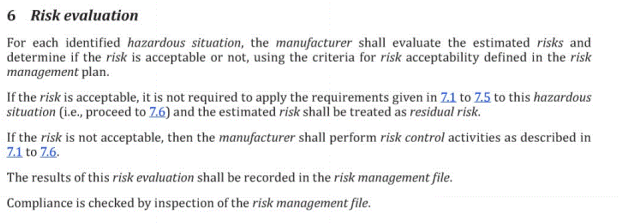
Whenever we come across risk management SOPs from different companies, we always keep an eye open for how that company solved the requirement 7.4 in ISO 14971 to perform a Risk vs Benefit Analysis as well as the handling of Residual Risks.

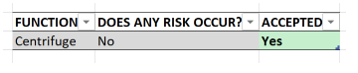
In excel-based approaches it is not uncommon to see something similar to the table below:

The QMS expects that each risk (representing one row) should be addressed in the spreadsheet. When I see this, I personally feel inclined to ask:

- What happens if someone in the team does not agree that the risk is acceptable, claims that the risk does not outweigh the benefits or simply cannot decide?

In many cases, these extra columns made it into the template after an audit of the QMS to quickly fix any audit findings, a somewhat unfortunate result of increasing regulations.

Let’s look at these requirements in a bit more detail.

Is the risk acceptable?

Answering this question is very much like shooting from the hip. Either the answer is trivial, e.g. the risk is frequent and severe, in which case we should definitely control the risk as per the procedure. The other complex scenario is that it very much depends on a lot of different factors. The complex scenario is only possible to answer in the scope of the benefit of the device. Still, we often come across it as an individual item in the risk analysis.

The solution is straightforward

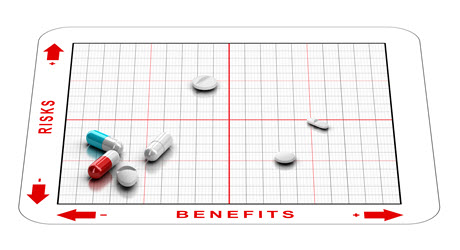
The principle of lowering risks as much as possible should be applied and when all possibilities for applying risk measures have been looked at, the company needs to do a proper Risk vs Benefit Assessment for the complete device.

Hint: The Risk Management Report is a good location for describing your Risk - Benefit Assessment and conclusion. 

Benefit-Risk Analysis

One could imagine that looking at an isolated function and weighing the risk towards the benefit of that function may give us an insight into if the function is acceptable for the device. However, in most cases, a function cannot be handled as an isolated part of the system, nor can the benefits of that function be easily compared to the risks it may impose on a user, patient, or operator.

E.g. Trying to argue that a power unit may impose risks to a patient but having the benefit that the device needs electricity to work is not a meaningful exercise.

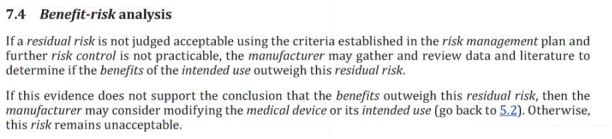
ISO 14971 (2019) is exceptionally clear in this matter:


Good reasoning and sensible pro:s and con:s are asked for

Here, we recommend looking at the Device as a whole. Will the discovered residual risks still make the device beneficial in the scope of the intended use of the device? In case of doubt, look at trying to apply additional Risk Control Measures to open risks. Remember that all identified risks, acceptable or not, are considered residual risks for the device. See ISO 14971 (2019) Section 6:


Once again: The Risk Management Report is a good location for recording this evaluation. 

New Risks?

Claiming that there are no residual risks involved is, in our opinion, not possible to handle in a spreadsheet column. The questions cannot simply be answered with a yes or no. Let me be a bit provocative and suggest that this question alone could replace any risk analysis method altogether. Something like this:

Although I’ve seen similar approaches at very large, established medical device manufacturers, I do not recommend this approach!

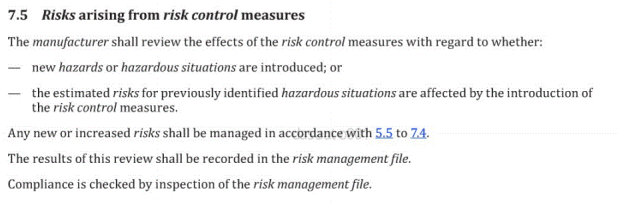
Here is what ISO 14971 (2019) has to say about it:

Bring the analysis to completion

Here we need to use our toolset properly and link the risk control measures to any implementing functions and continue with a new loop of risk analysis.

The outcome of that task will answer if there are still any residual risks present. This exercise may need to be repeated for any suggested risk control measures.

Finally, summarize all your findings in the risk management report and do not forget to remove these columns from your risk analysis templates!

{fastsocialshare}

Some of our most popular blog posts have involved discussions with Christian Kaestner, co-author of IEC 62304 and IEC 82304. He has brought us great insights into the underlying ideas of the people writing these standards and the standards' implications and interpretation throughout the industry.

You can tap into Mr. Kaestner's knowledge in his online course on medical device software and IEC 62304 in collaboration with Medical Device HQ

The full course is found here and a free short version is YouTube.

Once again, we have been fortunate enough to get a few minutes with Mr. Kaestner, who in this post elaborates on the current state of IEC 62304, 14 years after its initial release.

Q: With your extensive experience of both writing the standard and seeing how it has been used by the industry, how do today’s modern software companies approach and implement IEC 62304? Has IEC 62304 successfully stood the test of time? 

A: Well, both yes and no. Yes, because after almost 15 years the standard is now well known and established in the field. No, because the software environment has changed a lot since its first release in 2006. For example, the way we today use apps, cloud-based solutions, and AI, not to mention security aspects and the shift towards using Agile methods for software development! 

Q: Can we expect this to be covered by the upcoming edition 2? 

A: No, not really. I would say the main goal for edition 2 is to align better with IEC 82304-1, which is a product standard for health software (including medical device software). The scope of IEC 62304 edition 2 will be broadened from medical device software to health software.

This expansion has provided some challenges such as ISO 14971 for risk management is currently a normative reference, which means you must comply with also ISO 14971 to comply with IEC 62304. This cannot be required for general health software developers while risk management still is a vital part of a medical device software development process!          

Q: Many medical device software developers want to work Agile but find it difficult when reading IEC 62304, do you have any suggestions? 

A: It is no secret that the standard is written very sequentially and implies a classical V-model approach, but you are free to work in any way you want! If you struggle with implementing the standard, I suggest you consider the standard as a list of requirements that you have to fulfill but you can disregard the order in which they are written.

For example, there is a requirement to “Verify software requirements” but if you find it appropriate, you can do this as part of your software release. I will not say that it is formally incorrect, but I would argue it is a risky approach since late discoveries during the verification might generate a lot of re-work.

Likewise, if you use Scrum, it might be appropriate to include the activity “Verify software requirements” in for example sprint planning and verify the requirements contained in a sprint. You could even consider verifying software requirements on a story-based level!  


Figure 1: Incremental approach to verification of software requirements  

Q: The IEC 62304 Software Safety Classification seems to be the most contested part of the standard.  Is the industry using the Software Safety Classification the way it was intended according to you? Are there any aspects of it that you feel should receive more attention? 

A: Interesting questions indeed… There have been many discussions over the past years about whether Software Safety Classification is needed or not. Some argue that Class C software development is the current state-of-the-art, and anything less than that is simply not acceptable these days. Still, Software Safety Classification will survive and remain in edition 2 (with some editorial changes).

Personally, I like the risk-based approach for two reasons; firstly, it increases the likelihood for low-risk software devices to enter the market which otherwise would have been too expensive and not make it to the market. Secondly, it increases the awareness of what parts of your software can be dangerous.  

Q: Can you elaborate a bit more about your second point about awareness? 

A: Early awareness of what can become harmful is a super valuable input to the architectural design because, with this information at hand, you can separate risky and non-risk functionality into different items. If this is done correctly, you can assign the appropriate classification to items and concentrate your safety efforts where it makes the most sense! And this is the essence of IEC 62304: focus your efforts on the risky parts! 

Figure 2: Items in a software system can be classified differently 

A final point on Software Safety Classification: note that the concept is based on injury, not harm as in ISO 14971. Harm is a much broader concept than injury and includes damage to property and environment which strictly speaking does not need to be considered when determining a Software Safety Classification.  

Q: The IEC 62304 Problem Resolution chapter has received some heat regarding the (at least perceived) overly cumbersome approach. Do you think there is any substance to these claims? Are there any best practices for how to best tackle the Problem Resolution requirements of the standard?  

A: Yes, the Problem Resolution is a bit strange to follow in the standard. Throughout the standard, there are requirements to use a “problem resolution process”.

However, in most cases, it does not make sense to use such a process as it is defined by clause 9 “Software problem resolution process”. For example, if a bug is discovered during a system test and the software is still not on the market, it does not make sense to “advice relevant parties”! 

My approach to this is to use a scalable process and use different approaches depending on whether the problem relates to released functionality or not. Where a problem relates to a released functionality, regardless of found internally (“Internal feedback”) or externally (“Feedback”), then all parts of clause 9 apply.

For all other problems, I use selected parts of clause 9 and work with a generic software problem resolution process. 

Figure 3: An approach to manage software problem resolution process

About Christian Kaestner 

Christian has recently released an online course about medical device software and IEC 62304 in collaboration with Medical Device HQ. The full course can be found here, and if you are interested in a free short version, you can find it here on YouTube.

Christian Kaestner is a freelance software medical device consultant who often worksin close collaboration with QAdvis AB in Sweden. He is a member ofthe project team authoring IEC 62304 and was also part of the project team developing IEC 82304-1.

If you are developing medical devices, there are an awful lot of Design Control documents that need to be created.

There are several different ways of approaching that task.

Continue reading

{fastsocialshare}

Computer Software Validation is something we discuss a lot where I work. Since Aligned Elements is a Medical Device Quality Management System relevant software, our customers make sure that their Aligned Elements installations and configurations are validated.

It is a necessary activity, although not always perceived as bringing an awful lot of value. Sometimes the cost of CSV activities actually supersedes the cost of acquiring the software itself. 

I sometimes get the question if I know any best practices when it comes to Computer Software Validation and I have made a few observations from my CSV experiences. 

Let me tell you about the top 3 things that have an impact on the Computer Software Validation effort:

1) How many test cases do you perform?

It is dead simple. More test cases (note: not necessarily "more requirements") is more work. But do YOU have to perform all those test cases? What if the supplier has already verified them? 

You are very much allowed to leverage existing supplier documentation and testing records. A properly conducted Supplier / Vendor assessment can lead you to the conclusion that the suppliers' verification documentation suffices. Remember that the risk we are trying to mitigate with a Computer Software Validation effort is primarily about patient safety. A software like Aligned Elements is not directly involved in patient safety and this fact can be leveraged when assessing and deciding on the validation scope. 

2) How do you record the test results?

The bulk of the CSV work resides in performing and recording the test results. The way you record those results can have a significant impact on the overall effort. In order to record that the actual behavior of a test step corresponds to the expected behavior, is it enough to tick a box (passed/failed)? Or do you need to write a text? Or do you need to make screenshots? As you can imagine, there is a huge difference between the former and the latter.

"But are we not required to take screenshots?".  The short answer is "No, you don't". Not if you do not think it proves anything more than the tester checking a box. FDA requires you to select your own methods and tools for quality assurance. If you have a good case for not making screenshots (which I think you have), you do not have to.

3) Who (and how many) has to sign all these CSV documents?

This might sound a bit odd but more than once I have run into cases where the validation is completed and everything that is missing is a signature from some top management figure. And now we run into a buy-in problem. If this guy has not been involved CSV approach and suddenly disagrees with how it was conducted ("BUT THERE ARE NO SCREENSHOTS?!?"), it can have a significant impact (significant as in "redo the validation").

So the lesson here is to get early buy-in from the people that sign the document. On a general level, reducing the number of signatures will speed up any documentation process. And you might want to contemplate the necessity of having the IQ, OQ, and PQ plans/reports in different documents (more documents to sign) or if you can combine them.

Validating Aligned Elements

When you acquire Aligned Elements, you get free access to our internal verification documents to use in your vendor assessments as well as pre-filled Validation documents to kick-start your validation. Contact us for more information at This email address is being protected from spambots. You need JavaScript enabled to view it.

What's up ahead regarding Computer Software Validation?

FDA announced that their much anticipated "Computer Software Assurance for Manufacturing, Operations, and Quality System Software" draft guidance should be out in 2019 but now it seems like it has been postponed to 2020. The new guidance is supposed to use a more agile approach, including a risk-based and value-creating perspective on CSV activities.